7 Proven Secrets to Master the 25 Modifier Every Time
Medical billing is a minefield of codes, rules, and payer-specific policies, but few elements cause as much confusion—and as many lost dollars—as the 25 modifier. When applied correctly, the 25 modifier unlocks legitimate reimbursement for evaluation and management (E/M) services performed on the same day as a procedure. When misused, ignored, or poorly documented, the 25 modifier becomes a direct pipeline to claim denials, auditor recoupments, and compliance nightmares. At Icon Billing LLC, we’ve recovered thousands of dollars for practices simply by correcting their approach to the 25 modifier. In this definitive guide, you’ll learn what the 25 modifier really is, when to use it, how to document it flawlessly, and the seven proven secrets that turn the 25 modifier from a liability into a reliable revenue driver.
For many providers, the 25 modifier feels like a riddle wrapped in red tape. Some use it sparingly, fearing audits; others append the 25 modifier to nearly every E/M service, triggering automated denials and payer scrutiny. Both extremes hurt your bottom line. Mastering the 25 modifier is not about gaming the system—it’s about understanding the precise clinical and coding criteria that distinguish a separately identifiable service from a bundled one. Throughout this article, you will see the 25 modifier referenced again and again because it truly is that central to clean claims and a healthy revenue cycle. By the end, you’ll know exactly how to eliminate the devastating denials caused by the 25 modifier and build a compliant, profitable workflow.
What Is the 25 Modifier and Why It Matters
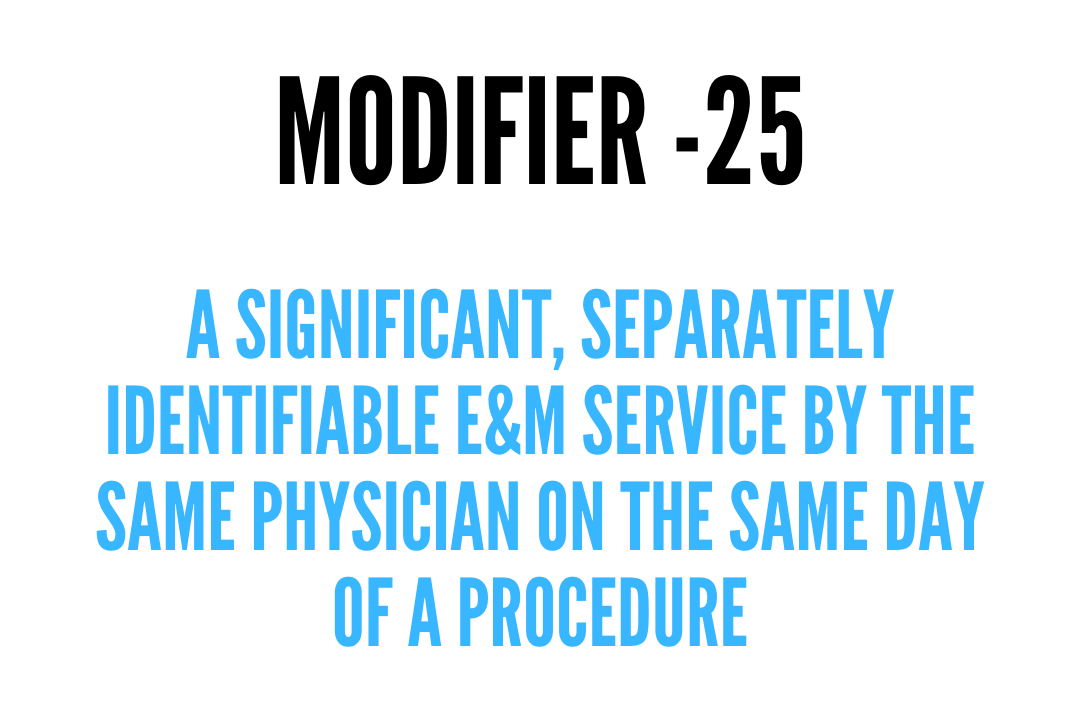
The 25 modifier is defined by the Current Procedural Terminology (CPT) as a modifier that indicates a “significant, separately identifiable evaluation and management service by the same physician or other qualified health care professional on the same day of the procedure or other service.” In plain language, the 25 modifier tells the payer that the E/M service you performed was above and beyond the usual pre- and post-procedure work included in the procedure’s reimbursement. Without the 25 modifier, the E/M service is considered bundled, and you won’t get paid separately for it. With a properly applied 25 modifier, you can bill both the E/M code and the procedure code and receive appropriate payment for each.
Why does the 25 modifier matter so much? Because E/M services represent a significant portion of primary care, specialty, and urgent care revenue. When a patient presents with a new problem that requires evaluation, and during that same visit you also perform a procedure—say, an excision, an injection, or a fracture care application—the 25 modifier allows you to capture the full value of your cognitive work. If your team doesn’t understand the 25 modifier, you’re leaving money on the table. Worse, if they misuse the 25 modifier, you’re inviting payers to deny the entire claim or, later, demand repayment. The 25 modifier is a high-stakes tool, and Icon Billing LLC makes it a centerpiece of our clean-claim strategy.
The Clinical Foundation of the 25 Modifier
To apply the 25 modifier correctly, you must first grasp its clinical foundation. The key phrase is “significant, separately identifiable.” The E/M service you’re billing with the 25 modifier must be distinct from the minor evaluation inherent in every procedure. Every procedure includes a certain amount of assessment—checking the site, reviewing the indication, obtaining consent. That’s not enough for a 25 modifier. A qualifying 25 modifier scenario requires that the provider perform additional work: a detailed history, a full physical examination of an unrelated area, medical decision-making for a new or worsened condition, or management of a chronic problem that goes well beyond the procedure’s requirements.
Consider a dermatologist who sees a patient for a full-body skin exam and, during that exam, identifies and removes a suspicious lesion. The skin exam and the decision to biopsy are part of a significant, separately identifiable service, so the E/M code with a 25 modifier is appropriate. Now imagine the same patient comes in specifically to have a lesion removed, and the dermatologist only examines that single lesion before the excision. That brief check is inherent to the procedure; the 25 modifier would be incorrect. The clinical documentation must clearly separate what was done for the E/M from what was done for the procedure. When Icon Billing LLC reviews your charts, we look for that distinct narrative that justifies the 25 modifier—and we train providers to document it clearly.
7 Proven Secrets to Master the 25 Modifier
Here are the seven secrets that transform the 25 modifier from a confusing concept into a predictable, revenue-boosting asset. Each secret builds on the last, creating a robust system for using the 25 modifier accurately.
Secret 1: Always Identify a Distinct Chief Complaint
A separate diagnosis or a distinct chief complaint is the strongest foundation for a 25 modifier. If the E/M service addresses a problem unrelated to the procedure, the 25 modifier is practically bulletproof. For example, a patient comes in for follow-up of hypertension and diabetes (the E/M), and during the visit, the physician also injects a painful joint. The 25 modifier attached to the E/M code for the chronic disease management is appropriate because the injection addresses a different issue. Even when the conditions are related, if the E/M service involves a new or acute worsening of the condition beyond the procedure itself, the 25 modifier may still be valid. Your documentation must spell out the separate chief complaint. Icon Billing LLC’s audits consistently find that a missing, vague, or identical chief complaint for both the E/M and the procedure is the number one reason a 25 modifier claim fails.
Secret 2: Document the E/M Service Completely and Separately
A successful 25 modifier claim depends on documentation that stands on its own. The note should include a dedicated E/M section that can be cleanly extracted from the procedure note. It must contain the key elements of history, physical examination, and medical decision-making appropriate to the level of service billed. If the only documentation is “examined the site and performed procedure,” the 25 modifier won’t survive even a basic audit. Train your providers to write a separate paragraph that begins with something like, “Separately identifiable E/M service performed today for…” This simple habit reinforces that the 25 modifier is grounded in reality, not wishful coding.
Secret 3: Nail the Medical Decision-Making (MDM)
Payers and auditors scrutinize the medical decision-making when a 25 modifier is present. Low-level MDM for an E/M service on the same day as a procedure can flag the claim. If the E/M service truly required significant evaluation—ordering labs, changing medications, coordinating care with other specialists—the MDM will naturally be higher, and the 25 modifier is more defensible. Don’t upcode to justify the 25 modifier, but do ensure the MDM accurately reflects the cognitive work done. When Icon Billing LLC works with practices, we analyze the MDM levels attached to 25 modifier claims to spot patterns of under-documentation before payers do.
Secret 4: Know the Payer-Specific 25 Modifier Rules
Medicare, Medicaid, and commercial carriers all have their own interpretations of the 25 modifier. Some payers, for instance, will not reimburse an E/M service with a 25 modifier if the procedure has a global period that already includes related E/M services. Others require the 25 modifier to be sequenced in a specific position on the claim form. A few national payers have publicly stated they use artificial intelligence to flag 25-modifier claims for review, automatically reducing or denying them if certain documentation isn’t submitted. At Icon Billing LLC, we maintain an up-to-date library of payer policies on the 25-modifier, ensuring your claims meet every technical requirement. Blindly applying the 25 modifier without knowing these nuances is a recipe for denials.
Secret 5: Use a Proactive Pre-Bill Audit Workflow
The best time to catch a 25-modifier error is before the claim leaves your system. Establish a pre-bill audit step that specifically checks every claim containing the 25-modifier. Verify that the E/M code is supported by a separately identifiable note, that the diagnosis linkage is sound, and that the payer’s rules are satisfied. This one habit can reduce 25-modifier denials by up to 80%. If your internal team lacks the bandwidth, Icon Billing LLC can perform this function as part of our full-service revenue cycle management, acting as a safety net for your 25-modifier claims.
Secret 6: Track Denials by Root Cause and Educate
When a 25-modifier claim does get denied, treat it as a learning opportunity, not just an annoyance. Categorize each denial by root cause: insufficient documentation, missing separate diagnosis, payer policy not followed, coding level mismatch. Then, share anonymized examples with your providers and coders in brief, monthly training sessions. A 15-minute discussion on real denials involving the 25-modifier is far more effective than a generic lecture. Over time, your team internalizes the specifics of what makes a 25-modifier defensible. Our clients at Icon Billing LLC who adopt this feedback loop see a dramatic drop in recurring 25-modifier errors.
Secret 7: Never Use the 25-Modifier as a Routine Add-On
A dangerous habit in some practices is appending the 25-modifier to every E/M service that occurs on the same day as a procedure, with the assumption that payers will just pay it. This practice invites systematic denials and puts the entire practice on a payer’s radar. The 25-modifier must be applied selectively, based on clinical merit, not billing convenience. If you find that a high percentage of your same-day visits include the 25-modifier, audit a sample immediately. Chances are, some of those do not meet the threshold. At Icon Billing LLC, we help practices establish a reasonable benchmark for 25-modifier usage frequency, flagging outlier patterns before payers launch a take-back audit.
Common Pitfalls and How to Avoid Them
Despite understanding the fundamentals, many practices still stumble with the 25-modifier. One frequent mistake is using the 25-modifier when a more specific modifier, like modifier 57 (decision for surgery), is required. While both indicate an E/M service on the day of a procedure, they are not interchangeable. The 25-modifier applies to E/M services that lead to minor procedures or treatments; modifier 57 is for the E/M service that results in a major surgical procedure with a 90-day global period. Applying the 25-modifier incorrectly when modifier 57 is indicated will trigger a denial, leaving money on the table.
Another pitfall is insufficient linkage to the correct ICD-10 codes. Even if the E/M service was significant, if the diagnosis codes don’t clearly distinguish the medical necessity for the E/M from the procedure, the 25-modifier claim may be rejected. Always ensure the E/M line on the claim form carries the ICD-10 code that reflects the separately identifiable condition. A patient who comes in for a diabetic foot ulcer evaluation and also receives a vaccine needs the diabetes/complication code linked to the E/M with the 25-modifier and the vaccine administration code linked to the Z23. Linkage tells the story in data form.
Lastly, don’t forget that time-based E/M coding can support the 25-modifier as well. If the provider spends a significant amount of time on counseling or coordination of care that is separate from the procedure, document the total time and the distinct nature of the discussion. The 25-modifier then applies to the time-based E/M code. Many practices overlook this option, losing legitimate revenue. Icon Billing LLC’s certified coders can flag these opportunities when they review your charts.
The Audit Risk of the 25-Modifier: Real but Manageable
The 25-modifier is a known audit trigger for both government and commercial payers. The Office of Inspector General (OIG) has repeatedly examined 25-modifier usage, finding a high rate of improper payments. Consequently, Recovery Audit Contractors (RACs) and Unified Program Integrity Contractors (UPICs) actively target 25-modifier claims. The fear of an audit causes some providers to avoid the 25-modifier entirely, which is a costly overreaction. With proper documentation, payer knowledge, and internal controls, the 25-modifier can be used confidently, even in a heightened enforcement environment.
Icon Billing LLC’s approach is to build an audit-proof 25-modifier process. We conduct regular internal compliance audits, mirroring the methodologies of RACs, to identify vulnerabilities before an outside auditor does. If an issue is found, we correct it, provide education, and if necessary, submit a voluntary refund. Far better to self-identify a small 25-modifier error than to have a payer extrapolate it across three years of claims. The 25-modifier can be your friend, but only if you respect its rules.
Specialty-Specific Guidance for the 25-Modifier
The 25-modifier is used across virtually all specialties, but the clinical scenarios vary. In orthopedics, the 25-modifier often pairs with an E/M for a new injury evaluation and a same-day injection or fracture care. In cardiology, an E/M for arrhythmia management plus a pacemaker check may require the 25-modifier if the E/M work is significant and separate. In primary care, the 25-modifier might cover a chronic disease management visit and a same-day skin biopsy. In each setting, the key is whether the provider performed and documented an E/M service that went well beyond the usual pre-procedure evaluation.
Icon Billing LLC works with a wide range of specialties, and we tailor our 25-modifier training to the specific codes, procedures, and payer mix of each practice. A pediatrician’s use of the 25-modifier for a well-child visit and a same-day immunization requires a different documentation strategy than a general surgeon’s use of the 25-modifier for a preoperative evaluation. There is no one-size-fits-all 25-modifier template, which is why expert billing support yields such a strong return on investment.
How Icon Billing LLC Transforms Your 25-Modifier Performance
When you partner with Icon Billing LLC, you gain a team that lives and breathes the 25-modifier and every other modifier that impacts your revenue. We begin with a comprehensive review of your past six to twelve months of 25-modifier claims. We analyze denial rates, payer patterns, and documentation quality. That baseline tells us exactly where your 25-modifier leakage is occurring. Then, we implement a customized plan: provider training, coding workflow adjustments, pre-bill scrub templates, and denial management protocols. The 25-modifier becomes a KPI (key performance indicator) that we track monthly, showing you in clear numbers how your improved 25-modifier practices are increasing collections.
Our team also keeps you ahead of policy changes. When a major payer suddenly announces that it will require manual medical review on all 25-modifier claims of a certain code combination, we alert you immediately and adjust your submission process. The 25-modifier landscape is constantly shifting, but Icon Billing LLC treats it as a core competency. Because we manage the revenue cycle end-to-end, the 25-modifier is never an afterthought; it’s embedded in every step from scheduling to payment posting.
The Cost of Getting the 25-Modifier Wrong
To fully appreciate the importance of the 25-modifier, consider the numbers. A mid-sized primary care practice that performs 500 same-day E/M and procedure visits a year might miss $50,000 to $100,000 in legitimate E/M revenue if it fails to use the 25-modifier correctly. Even a 10% improper denial rate on 25-modifier claims can equate to tens of thousands of dollars annually. And that’s just the lost revenue. Add in the administrative cost of reworking denied 25-modifier claims—staff time for appeals, corrected claims, and phone calls—and the financial drain multiplies.
On the flip side, a practice that overuses the 25-modifier exposes itself to extrapolated overpayment demands. We’ve seen RAC audits where a single improperly applied 25-modifier was deemed a billing error pattern, resulting in a demand letter for hundreds of thousands of dollars. The 25-modifier is not a small detail; it is a financial lever that can lift your practice or snap it back painfully. Icon Billing LLC’s mission is to make sure your 25-modifier usage is a lever for growth, never a source of risk.
Steps You Can Take Today to Improve Your 25-Modifier Compliance
You don’t have to wait for a full-scale billing overhaul to start improving. Pick one of these actions and implement it this week:
-
Print a report of all claims from the past 30 days that contain the 25-modifier and spot-check ten charts for documentation quality.
-
Ask your top three payers for their current written policies on the 25-modifier and circulate them to your coders.
-
Hold a 15-minute huddle with your providers to review one well-documented 25-modifier example and one poor example from your own charts.
-
Have Icon Billing LLC conduct a free, no-obligation 25-modifier risk assessment for your practice.
These small steps immediately raise awareness and begin to shift the culture around the 25-modifier from casual to precise. The 25-modifier responds to diligence and clarity, and even modest improvements in documentation and coding accuracy can yield substantial revenue gains.
Conclusion: Mastering the 25-Modifier as a Competitive Advantage
In today’s challenging reimbursement environment, every dollar counts, and the 25-modifier is a prime candidate for revenue recovery. When you understand the clinical logic, document thoroughly, stay current with payer rules, and build a strong pre-bill and post-bill audit process, the 25-modifier becomes a reliable source of legitimate income rather than a source of anxiety. Icon Billing LLC partners with practices just like yours to turn the 25-modifier from a headache into a competitive advantage. We provide the expertise, the processes, and the ongoing vigilance that make the 25-modifier work for you, not against you.
Stop letting devastating denials and confusing rules rob your practice of the revenue it has rightfully earned. Embrace the 25-modifier with the confidence that comes from having a dedicated team of billing experts on your side. Contact Icon Billing LLC today to schedule your consultation. Together, we’ll diagnose your 25-modifier challenges, prescribe a tailored solution, and watch your clean-claim rate—and your bottom line—climb higher than ever. The 25-modifier doesn’t have to be a mystery; with Icon Billing LLC, it becomes your pathway to a stronger, more resilient revenue cycle.