
7 Devastating HFrEF ICD 10 Coding Mistakes That Destroy Cardiology Revenue – Ultimate Fix Guide
Heart failure with reduced ejection fraction—commonly abbreviated HFrEF—is one of the most clinically significant and financially sensitive diagnoses in cardiology. Patients with HFrEF require ongoing evaluation, medication management, device therapy, and close monitoring. Every encounter generates claims that depend on accurate HFrEF ICD 10 coding. When HFrEF ICD 10 coding is precise, payers see the severity and medical necessity of the services provided. When HFrEF ICD 10 coding is vague, inconsistent, or incorrect, claims deny, audits loom, and revenue leaks away. At Icon Billing LLC, we have seen cardiology practices lose substantial revenue because of preventable HFrEF ICD 10 errors, and we have helped them recover. This guide exposes seven devastating HFrEF ICD 10 coding mistakes and shows you exactly how to avoid them.
This comprehensive guide is written for cardiologists, advanced practice providers, practice managers, and billing professionals who support heart failure programs. You will learn how HFrEF ICD 10 codes are structured, how to document ejection fraction and acuity, how to link HFrEF ICD 10 codes to medications and procedures, and how to build a coding workflow that produces clean claims. Whether you are new to HFrEF ICD 10 coding or looking to tighten an existing process, these seven mistakes are the ones that cause the most revenue loss. Let’s dive into the details and transform your HFrEF ICD 10 coding from a vulnerability into a strength.

What Is HFrEF ICD 10 and Why Does It Matter?
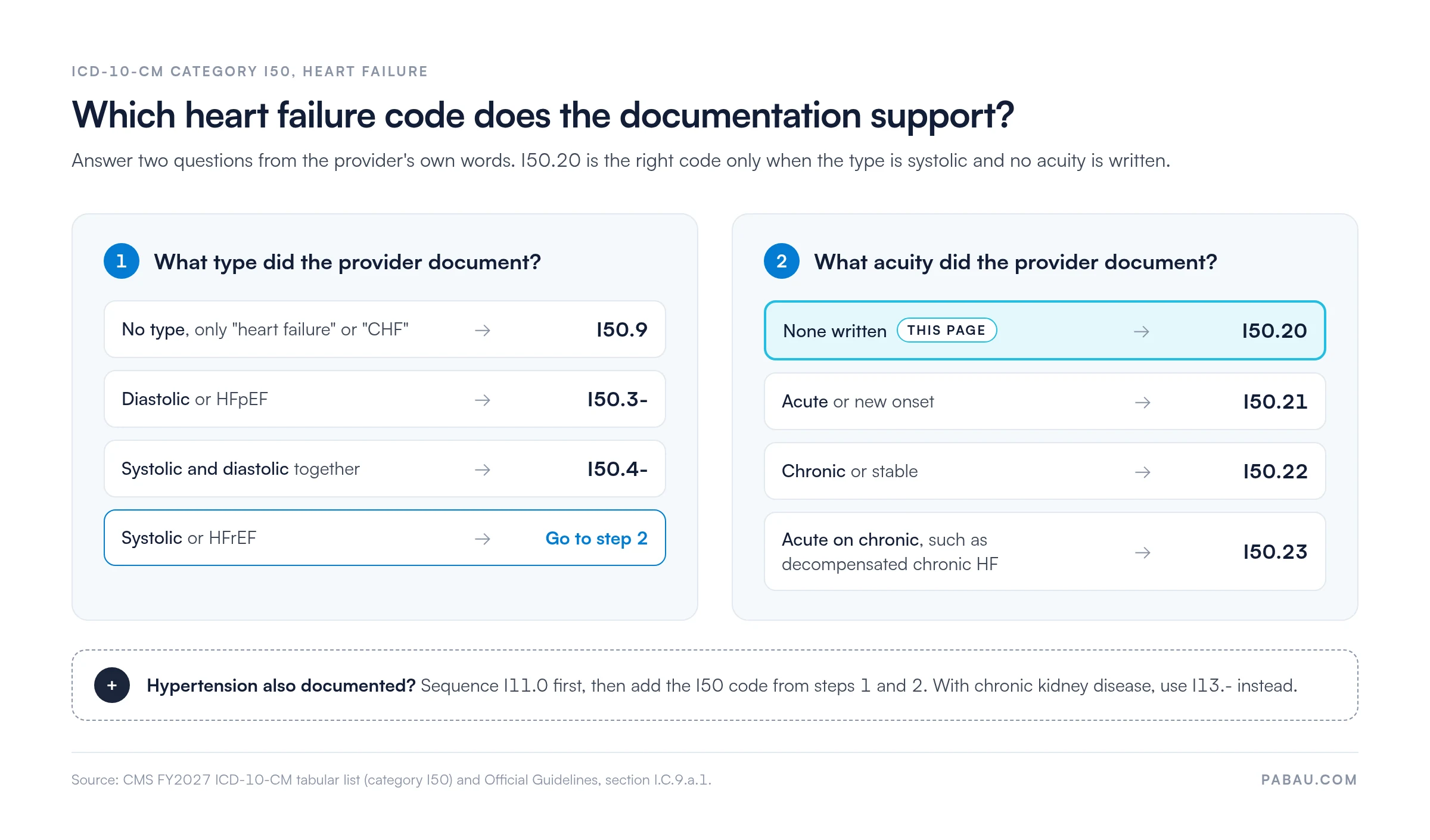
HFrEF ICD 10 refers to the ICD-10-CM diagnosis codes used to report systolic heart failure—heart failure with reduced ejection fraction—on medical claims. The core HFrEF ICD 10 code family is I50.2-. The specific code depends on acuity. I50.20 is unspecified systolic (congestive) heart failure. I50.21 is acute systolic (congestive) heart failure. I50.22 is chronic systolic (congestive) heart failure. I50.23 is acute on chronic systolic (congestive) heart failure. The HFrEF ICD 10 code must reflect the patient’s documented clinical status, including whether the heart failure is acute, chronic, or acute on chronic.
HFrEF ICD 10 coding matters because payers use the diagnosis to determine medical necessity, risk adjustment, and quality reporting. Heart failure is a major component of Hierarchical Condition Category (HCC) coding, which influences Medicare Advantage payment rates and quality scores. An inaccurate HFrEF ICD 10 code does not just affect today’s claim—it distorts risk adjustment, undermines quality metrics, and can trigger audits. For cardiology practices committed to both clinical excellence and financial health, HFrEF ICD 10 accuracy is non-negotiable.
Devastating Mistake #1: Using I50.20 for Every HFrEF Patient
The most common HFrEF ICD 10 mistake is defaulting to I50.20—unspecified systolic heart failure—for every patient with reduced ejection fraction. I50.20 should be used only when the documentation does not specify whether the heart failure is acute or chronic. If the patient is being seen for an acute exacerbation, the correct HFrEF ICD 10 code is I50.21. If the patient has stable chronic systolic heart failure, the correct HFrEF ICD 10 code is I50.22. If the patient has chronic heart failure with an acute exacerbation, the correct HFrEF ICD 10 code is I50.23.
Using I50.20 when a more specific HFrEF ICD 10 code is supported understates the severity of the patient’s condition and weakens the claim. Payers may deny medications, diagnostic tests, or procedures as not medically necessary when the HFrEF ICD 10 code suggests an unspecified condition. Icon Billing LLC’s cardiology coding specialists review documentation for acuity and assign the most specific HFrEF ICD 10 code. We train providers to document whether the patient is acute, chronic, or acute on chronic, eliminating one of the most frequent causes of HFrEF ICD 10 denials.
Devastating Mistake #2: Failing to Document and Code the Ejection Fraction
A second devastating HFrEF ICD 10 mistake is failing to document the ejection fraction. HFrEF is defined by a reduced ejection fraction, typically 40% or below. The clinical documentation should include the most recent ejection fraction value, the date it was measured, and the method used. Without that documentation, the HFrEF ICD 10 code may be questioned, and payers may deny services that depend on the diagnosis. A vague note that says “heart failure” without specifying systolic dysfunction or ejection fraction is insufficient for HFrEF ICD 10 coding.
The solution is to document the ejection fraction clearly and consistently. When the ejection fraction is measured by echocardiogram, MRI, or nuclear imaging, the report should be referenced in the note. The HFrEF ICD 10 code should be supported by that objective data. Icon Billing LLC helps cardiology practices implement documentation templates that prompt for ejection fraction, acuity, and symptoms. We review HFrEF ICD 10 claims for documentation sufficiency before submission. When documentation supports HFrEF ICD 10, claims pay and audits become less threatening.
Devastating Mistake #3: Confusing HFrEF with HFpEF or Other Heart Failure Types
A third HFrEF ICD 10 mistake is confusing heart failure with reduced ejection fraction with heart failure with preserved ejection fraction (HFpEF) or other heart failure types. HFpEF uses the I50.3- code family. If the documentation says “diastolic heart failure” or “preserved ejection fraction,” the HFrEF ICD 10 code is not appropriate. Using a systolic heart failure code for a patient with preserved ejection fraction misrepresents the condition and can trigger denials or audit findings.
The solution is to verify the type of heart failure before assigning HFrEF ICD 10 codes. The documentation should clearly state “systolic heart failure,” “HFrEF,” or “reduced ejection fraction.” If the type is unclear, query the provider. Icon Billing LLC’s coding team reviews the clinical note for heart failure type and assigns the correct HFrEF ICD 10 code only when the documentation supports it. When HFrEF ICD 10 coding matches the clinical type, claims are more accurate and denials decrease.
Devastating Mistake #4: Failing to Link HFrEF ICD 10 Codes to Medications and Procedures
In cardiology billing, the HFrEF ICD 10 code must support the medical necessity of the medication or procedure billed. Guideline-directed medical therapy for HFrEF includes beta-blockers, ACE inhibitors, ARBs, ARNIs, mineralocorticoid receptor antagonists, and SGLT2 inhibitors. Device therapy such as ICD or CRT may be indicated. Diagnostic tests such as echocardiography and BNP testing are common. A devastating HFrEF ICD 10 mistake is billing these services with a vague or incorrect diagnosis code that does not justify the service.
Code linkage is essential. Icon Billing LLC’s pre-bill scrub checks that every medication and procedure is supported by a specific HFrEF ICD 10 code and that the documentation establishes the need for the service. We help providers document symptom severity, ejection fraction, and guideline-directed therapy. When HFrEF ICD 10 coding and procedure coding align, denials drop and reimbursement improves.
Devastating Mistake #5: Ignoring Payer-Specific HFrEF ICD 10 Rules
Medicare, Medicaid, and commercial payers each have their own HFrEF ICD 10 coverage policies. Some payers require prior authorization for certain heart failure medications or devices. Some have specific documentation requirements for echocardiography or BNP testing. Some deny claims when the HFrEF ICD 10 code does not match the payer’s medical policy. Ignoring these payer-specific rules is a costly HFrEF ICD 10 mistake.
Icon Billing LLC maintains a library of payer-specific HFrEF ICD 10 policies. We apply the correct rules to every claim, ensuring prior authorizations are obtained and documentation meets each payer’s requirements. We track policy changes and update workflows. When you work with us, your HFrEF ICD 10 claims are built for each payer’s unique rules, reducing denials and speeding payment.
Devastating Mistake #6: Inadequate Documentation for HFrEF ICD-10 Coding
HFrEF ICD-10 coding is only as good as the documentation behind it. If the provider’s note says only “heart failure” without specifying systolic dysfunction, acuity, ejection fraction, or symptoms, the coder cannot assign a specific HFrEF ICD-10 code. The claim may deny for lack of medical necessity, or the practice may undercode and lose revenue. Documentation must include the clinical findings, the ejection fraction, the acuity, and the treatment plan.
Icon Billing LLC helps cardiology practices improve documentation for HFrEF ICD-10 coding. We provide templates that prompt for ejection fraction, New York Heart Association class, symptoms, and guideline-directed therapy. We train providers to document the clinical story that supports the HFrEF ICD-10 code and the procedure. Better documentation leads to cleaner claims and stronger audit defense.
Devastating Mistake #7: Failing to Audit and Educate Around HFrEF ICD-10
The final HFrEF ICD-10 mistake is treating it as a simple code that does not require auditing or education. HFrEF ICD-10 coding has specific acuity, documentation, and linkage requirements. Without regular audits, errors repeat. A practice may consistently use I50.20 for acute patients or fail to document ejection fraction. Denials accumulate silently.
The solution is regular HFrEF ICD-10 audits and education. Audit a sample of HFrEF ICD-10 claims each month, compare the claim to the documentation, and track error patterns. Provide feedback to providers and billers. Icon Billing LLC performs HFrEF ICD-10 audits as part of our cardiology billing services. We identify recurring errors, correct them, and train your team. When HFrEF ICD-10 is audited and educated, accuracy improves and revenue stabilizes.
Building a Winning HFrEF ICD-10 Coding Workflow
Here is the proactive HFrEF ICD-10 workflow Icon Billing LLC recommends:
-
Confirm the heart failure type. Use HFrEF ICD-10 codes only when systolic dysfunction or reduced ejection fraction is documented.
-
Document ejection fraction. Include the value, date, and method in the clinical note.
-
Capture acuity. Use I50.21 for acute, I50.22 for chronic, and I50.23 for acute on chronic HFrEF ICD-10 coding.
-
Link the HFrEF ICD-10 code to medications and procedures. Ensure medical necessity is clear.
-
Apply payer-specific rules. Obtain prior authorization when required.
-
Perform pre-bill audits. Review HFrEF ICD-10 coding before submission.
-
Track denials by root cause. Identify HFrEF ICD-10 error patterns and correct them.
-
Provide ongoing education. Keep providers and billers current on HFrEF ICD-10 changes.
This workflow transforms HFrEF ICD-10 coding from a source of denials into a reliable revenue driver. Icon Billing LLC executes it daily for cardiology practices.
How Icon Billing LLC Transforms HFrEF ICD-10 Coding Success
When you partner with Icon Billing LLC, you gain a team that understands HFrEF ICD-10 coding and cardiology revenue cycle management. Our services include:
-
HFrEF ICD-10 coding audits to identify errors and missed revenue.
-
Pre-bill claim scrubbing that catches HFrEF ICD-10 mistakes before submission.
-
Denial management that recovers revenue from incorrectly coded HFrEF ICD-10 claims.
-
Provider education that improves documentation for HFrEF ICD-10.
-
Payer policy tracking that keeps HFrEF ICD-10 billing current.
-
Compliance support that protects against audit risk.
Our goal is to make HFrEF ICD-10 a strength of your cardiology practice, not a source of anxiety. We have helped practices improve clean claim rates, reduce denials, and recover lost revenue through disciplined HFrEF ICD-10 management.
Real-World Consequences of HFrEF ICD-10 Errors
Consider these composite examples based on cases we have encountered:
Scenario 1: A cardiology practice used I50.20 for all systolic heart failure patients, including acute admissions. Claims for inpatient consultations and IV diuresis denied for lack of specificity. Icon Billing LLC corrected the HFrEF ICD-10 coding to I50.21 or I50.23 and recovered $54,000 in denied revenue.
Scenario 2: A practice billed echocardiography and BNP testing without documenting ejection fraction. The payer denied the claims as not medically necessary. Icon Billing LLC implemented a HFrEF ICD-10 documentation template and reduced denials to under 4%.
Scenario 3: A practice failed to link HFrEF ICD-10 codes to guideline-directed medication management visits. Claims for complex medication titration were downcoded. Icon Billing LLC corrected the linkage and recovered $28,000 in underpaid revenue.
In each case, disciplined HFrEF ICD-10 management would have prevented the loss.
Frequently Asked Questions About HFrEF ICD-10
Q: What is the correct HFrEF ICD-10 code for chronic systolic heart failure?
A: I50.22 is the HFrEF ICD-10 code for chronic systolic (congestive) heart failure.
Q: What is the correct HFrEF ICD-10 code for acute systolic heart failure?
A: I50.21 is the HFrEF ICD-10 code for acute systolic (congestive) heart failure.
Q: When should I use I50.23?
A: Use I50.23 for acute on chronic systolic heart failure. This HFrEF ICD-10 code captures both the chronic condition and the acute exacerbation.
Q: Does HFrEF ICD-10 coding require documentation of ejection fraction?
A: Yes. The documentation should include the ejection fraction value and date to support the HFrEF ICD-10 code and medical necessity.
Q: How can Icon Billing LLC help with HFrEF ICD-10 coding?
A: We provide HFrEF ICD-10 audits, pre-bill scrubbing, denial management, provider education, and payer policy support.
Proactive Steps You Can Take Today
-
Audit recent HFrEF ICD-10 claims for I50.20 overuse and missing acuity.
-
Review documentation templates to capture ejection fraction and heart failure type.
-
Verify payer rules for HFrEF ICD-10 and procedure coverage.
-
Contact Icon Billing LLC for a comprehensive HFrEF ICD-10 coding review.
Conclusion: Master HFrEF ICD-10 for Maximum Cardiology Reimbursement
The seven devastating mistakes—using I50.20 for every patient, failing to document ejection fraction, confusing HFrEF with HFpEF, failing code linkage, ignoring payer rules, inadequate documentation, and neglecting audits—are all avoidable. HFrEF ICD-10 coding is complex, but it can be mastered. With the right training, processes, and partner, your cardiology practice can submit clean, accurate, compliant claims every time.
Icon Billing LLC is dedicated to making HFrEF ICD-10 coding a strength of your practice. Contact us today to learn how our HFrEF ICD-10 management service can improve your clean claim rates, reduce denials, and maximize reimbursement. Your patients deserve excellent heart failure care—and your practice deserves to be paid for that care. With the right HFrEF ICD-10 strategy, you can have both.