7 Devastating Mistakes in Coding CPT Codes That Destroy Your Revenue – Ultimate Fix Guide
Coding CPT codes is one of the most consequential tasks in medical billing. Every claim you submit depends on the accurate selection of Current Procedural Terminology codes, the five-character codes that tell payers exactly what service was provided. When coding CPT codes is precise, claims flow, payments arrive, and compliance risk stays low. When coding CPT codes goes wrong—through upcoding, undercoding, modifier errors, or outdated code sets—denials pile up, audits loom, and revenue leaks away. At Icon Billing LLC, we have seen practices lose hundreds of thousands of dollars because of preventable mistakes in coding CPT codes, and we have helped them recover. This guide exposes seven devastating errors in coding CPT codes and shows you how to fix them.
Whether you are a solo practitioner, a multi-specialty group, or a billing professional supporting healthcare providers, mastering coding CPT codes is essential. The complexity of coding CPT codes—thousands of codes, annual updates, payer-specific rules, and modifier combinations—creates endless opportunities for error. But with the right knowledge, the right processes, and the right partner, those errors are avoidable. Let’s dive into the seven most costly mistakes in coding CPT codes and build a path toward clean claims and maximum reimbursement.
What Is Coding CPT Codes and Why Does It Matter?
Coding CPT codes is the process of translating clinical services into the standardized procedure codes maintained by the American Medical Association. These codes describe medical, surgical, and diagnostic services and are required on virtually every claim submitted to Medicare, Medicaid, and commercial payers. Coding CPT codes accurately is not just a billing task—it is the foundation of reimbursement, quality reporting, and compliance.
Coding CPT codes matters because payers use these codes to determine payment, medical necessity, and adherence to billing rules. The wrong code can mean underpayment, denial, or even allegations of fraud. Coding CPT codes also drives risk adjustment and quality metrics under programs like MIPS. When coding CPT codes is inaccurate, it distorts your practice’s data, invites audits, and can trigger penalties. For practices committed to financial health and clinical integrity, coding CPT codes accurately is non-negotiable.
Devastating Mistake #1: Upcoding When Coding CPT Codes
Upcoding occurs when a provider submits a CPT code for a higher level of service than was performed or documented. For example, billing a level 5 evaluation and management visit when the documentation supports only a level 3 visit. Upcoding is not just an error in coding CPT codes—it is fraud. Payers audit for upcoding patterns, and the consequences include recoupment, civil monetary penalties, exclusion from federal programs, and even criminal charges in egregious cases.
The pressure to upcode often comes from a desire to maximize revenue, but the long-term cost far exceeds any short-term gain. The solution is rigorous accuracy when coding CPT codes. Coders must match the code exactly to the documentation, with no shortcuts. Providers must document thoroughly so that coding CPT codes reflects the true level of service. Icon Billing LLC performs regular audits of coding CPT codes to detect upcoding patterns before payers do. We provide feedback that keeps your coding accurate, compliant, and optimized for appropriate reimbursement.
Devastating Mistake #2: Undercoding When Coding CPT Codes
Undercoding is the opposite of upcoding—assigning a lower-level CPT code than the documentation supports. While undercoding does not carry the same legal risk, it silently drains revenue by systematically underbilling for services. A practice that consistently codes level 3 visits when the documentation supports level 4 visits loses 20–30% of E/M revenue. Over a year, that adds up to tens or even hundreds of thousands of dollars.
Undercoding often stems from fear of audits, inadequate coder training, or incomplete documentation. The solution is confident, accurate coding CPT codes based on complete documentation. Coders must be trained to recognize when a higher-level code is justified and to assign it without hesitation. Providers must document all the elements that support higher-level codes. Icon Billing LLC helps practices identify undercoding patterns through audits and provides education that empowers coders to bill accurately when coding CPT codes. We ensure that you are paid fairly for every service you provide.
Devastating Mistake #3: Misapplying Modifiers When Coding CPT Codes
Modifiers are two-character codes appended to CPT codes to provide additional information about the service performed. They indicate multiple procedures, bilateral services, reduced services, or distinct procedural services. Incorrect modifier usage is a devastating error in coding CPT codes because it can cause automatic denials, payment reductions, or audit flags. Failing to append modifier -25 to a significant, separately identifiable E/M service performed on the same day as a procedure means the E/M service will not be paid. Appending modifier -59 incorrectly to bypass an edit can trigger a fraud investigation.
Proper modifier use requires deep knowledge of payer policies and CPT guidelines. Each modifier has specific criteria that must be met and documented. Your coding team must understand when to use -25, -59, -X{EPSU}, -LT, -RT, and dozens of other modifiers. Icon Billing LLC’s coding specialists are experts in modifier application when coding CPT codes. We review every claim for correct modifier usage before submission, eliminating one of the most common causes of denials and compliance risk.
Devastating Mistake #4: Failing to Link CPT Codes to Diagnosis Codes
In medical billing, the CPT codes must be supported by the diagnosis codes on the claim. This is called code linkage. A devastating error occurs when a coder assigns a CPT code that does not match the diagnoses. For example, billing a chest X-ray with a diagnosis of knee pain will be denied because the diagnosis does not support the medical necessity of the chest X-ray. The payer sees a nonsensical combination and rejects the claim.
Code linkage errors often occur when coding CPT codes is rushed or when coders work from incomplete encounter forms. They can also occur when providers use generic templates that pull in diagnoses unrelated to the procedure. The solution is careful, deliberate coding that ensures every CPT code is backed by a corresponding diagnosis code. Icon Billing LLC’s pre-bill claim scrub includes automated and manual checks for code linkage. We catch mismatches before they reach the payer, preventing denials and protecting your revenue.
Devastating Mistake #5: Using Outdated or Deleted CPT Codes
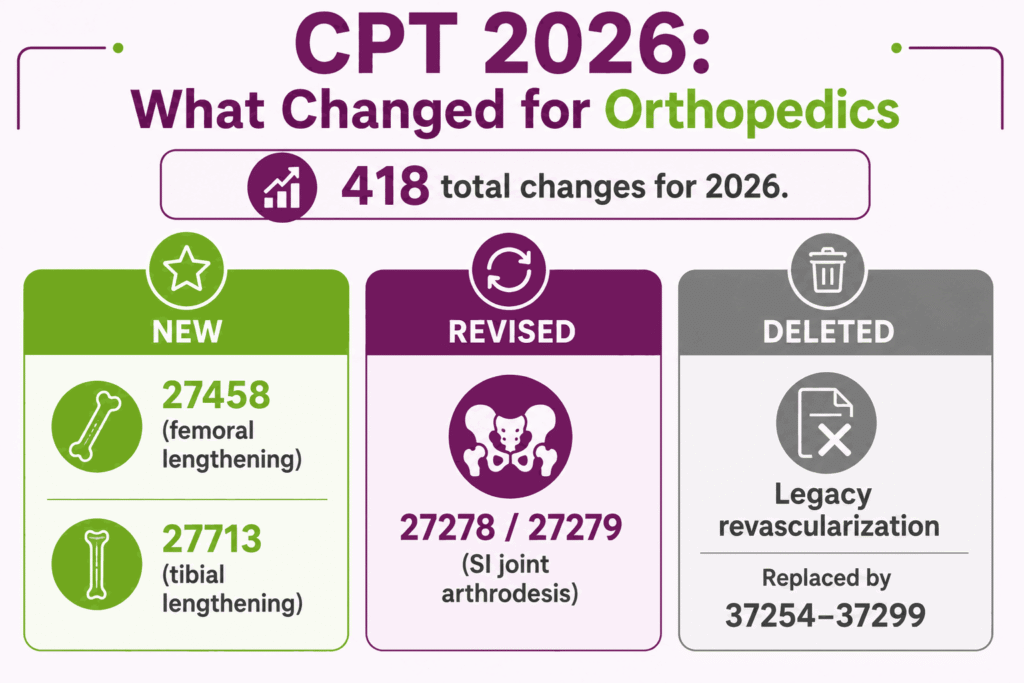
The CPT code system is updated annually. New codes are added, old codes are revised, and some codes are deleted entirely. Using outdated or deleted codes when coding CPT codes will cause claims to be rejected. Codes valid in 2023 may have been replaced or deleted in 2024. A coder who has not updated their code books or software will continue submitting claims with invalid codes, triggering automatic rejections.
The solution is to maintain current CPT resources and update coding software annually. Coding staff must receive training on code changes each year. Icon Billing LLC stays current on all CPT updates, including the annual January 1st changes. We apply the most current codes when coding CPT codes on every claim, ensuring that your submissions are never rejected due to outdated coding.
Devastating Mistake #6: Failing to Capture All Billable Services When Coding CPT Codes
Many practices leave money on the table by failing to bill for all services provided. This happens when providers perform services but do not document them adequately, or when coders overlook billable services in the documentation. For example, a provider might perform a smoking cessation counseling session during an annual wellness visit but fail to document it separately, missing the opportunity to bill the additional CPT code. Over time, these missed opportunities add up to significant lost revenue.
The solution is thorough documentation and comprehensive coding. Providers must document every service they provide, no matter how minor it seems. Coders must review documentation carefully to identify every billable CPT code when coding CPT codes. Icon Billing LLC helps practices implement documentation protocols that capture all billable services and coding workflows that identify every reimbursable CPT code. We ensure that you are paid for all the work you do.
Devastating Mistake #7: Failing to Invest in Ongoing Education for Coding CPT Codes
The CPT landscape is not static. Codes change annually, guidelines evolve, and payer policies shift. A devastating mistake is assuming that once your coding team knows the CPT codes, they are trained forever. Without ongoing education, coders fall behind on code updates, new regulations, and emerging best practices. Their accuracy when coding CPT codes declines, and denials increase. The financial impact accumulates silently, month after month.
The solution is continuous investment in education for coding CPT codes. Coders should receive regular training on code changes, payer policies, and documentation requirements. They should also participate in professional development through organizations like AAPC or AHIMA. Icon Billing LLC provides ongoing education as part of our comprehensive billing services. Our coders are certified, current, and continuously learning. When you partner with us, you gain access to a team that treats coding CPT codes as a dynamic, evolving discipline—not a static skill.
Building a Winning Workflow for Coding CPT Codes
Now that the mistakes are clear, here is the proactive workflow Icon Billing LLC follows when coding CPT codes:
-
Capture Complete Documentation. Providers should document every service thoroughly, including complexity, time spent, and medical necessity.
-
Assign Codes Deliberately. Coders should assign CPT codes based solely on documentation, never assumptions. When documentation is unclear, query the provider.
-
Apply Modifiers Correctly. Use modifiers only when documentation supports them and payer policies allow them.
-
Verify Code Linkage. Confirm that every CPT code is supported by a corresponding diagnosis code.
-
Use Current Codes. Apply only the most current CPT codes, avoiding outdated or deleted codes.
-
Identify All Billable Services. Review documentation to ensure every billable service is captured with the appropriate CPT code.
-
Perform Pre-Bill Audits. Review a sample of coded claims before submission to catch errors.
-
Track Denials by Root Cause. Analyze denied claims to identify error patterns in coding CPT codes and implement corrective actions.
This workflow transforms coding CPT codes from a source of confusion into a structured, reliable process. Icon Billing LLC executes it daily for practices across multiple specialties, producing clean claims and healthy revenue.
How Icon Billing LLC Transforms Success in Coding CPT Codes
When you partner with Icon Billing LLC, you gain a team of certified coding professionals who understand the nuances of accurate CPT code selection. Our services include:
-
Comprehensive coding audits to identify errors and missed revenue opportunities in coding CPT codes.
-
Pre-bill claim scrubbing that catches mistakes before submission.
-
Denial management that recovers revenue from incorrectly coded claims.
-
Provider education that improves documentation and accuracy in coding CPT codes.
-
Payer policy tracking that keeps your coding current with changing requirements.
-
Compliance support that protects you from audit risk.
Our goal is to make coding CPT codes a strength of your practice, not a source of anxiety. We have helped practices improve clean claim rates, reduce denials, and recover lost revenue through disciplined coding CPT codes management.
Real-World Consequences of Errors in Coding CPT Codes
Consider these composite examples based on cases we have encountered:
Scenario 1: A primary care practice consistently undercoded E/M services because providers feared audits. The practice lost an estimated $120,000 annually in legitimate revenue. Icon Billing LLC conducted an audit of coding CPT codes, identified the undercoding pattern, and provided education that corrected the issue.
Scenario 2: An orthopedic practice incorrectly applied modifier -59 to bypass bundling edits on multiple procedures. A payer audit flagged the pattern, and the practice was forced to repay $85,000. Icon Billing LLC reviewed their practices for coding CPT codes, corrected the modifier usage, and implemented pre-bill checks to prevent recurrence.
Scenario 3: A cardiology practice used outdated CPT codes that had been deleted in the annual update. Claims were rejected for invalid codes, causing a 12% denial rate. Icon Billing LLC updated the coding resources and eliminated the problem in coding CPT codes.
In each case, disciplined management of coding CPT-codes would have prevented the loss. Icon Billing LLC exists to ensure your practice never suffers from these preventable errors.
Frequently Asked Questions About Coding CPT-Codes
Q: How often do CPT codes change?
A: CPT codes are updated annually, with changes effective January 1st each year. New codes are added, old codes are revised, and some are deleted.
Q: What is the difference between CPT codes and ICD-10 codes?
A: CPT codes describe procedures and services. ICD-10 codes describe diagnoses and conditions. Both are required on medical claims.
Q: How can I improve my practice’s accuracy in coding CPT-Codes?
A: Invest in certified coders, provide ongoing education, implement pre-bill audits, and partner with a professional billing company like Icon Billing LLC.
Q: Can errors in coding CPT-codes trigger audits?
A: Yes. Patterns of incorrect coding—especially upcoding, unbundling, or incorrect modifier use—can trigger payer audits and compliance investigations.
Q: What should I do if I discover an error in coding CPT-codes on a submitted claim?
A: File a corrected claim as soon as possible. Icon Billing LLC can help you identify and correct errors on submitted claims.
Proactive Steps You Can Take Today
-
Audit a sample of your recent claims to identify error patterns in coding CPT-codes. Look for upcoding, undercoding, modifier issues, and linkage problems.
-
Review your documentation templates to ensure they capture all the details needed for accurate coding CPT-codes.
-
Invest in continuing education for your coding team. A single training session on coding CPT-codes can prevent thousands of dollars in denials.
-
Contact Icon Billing LLC for a comprehensive review of your coding CPT-codes process. We will assess your current accuracy, identify risks, and implement corrective actions.
Conclusion: Master Coding CPT-Codes for Maximum Reimbursement
The seven devastating mistakes—upcoding, undercoding, misapplying modifiers, failing code linkage, using outdated codes, missing billable services, and neglecting ongoing education—are all avoidable with discipline and expertise. Coding CPT-codes is complex, but it can be mastered. With the right knowledge, the right processes, and the right partner, your practice can submit clean, accurate, and compliant claims every time.
Icon Billing LLC is dedicated to making coding CPT-codes a strength of your practice. We bring the knowledge, the processes, and the vigilance needed to protect your revenue and keep your claims flowing. Do not let preventable errors in coding CPT-codes drain your practice’s financial health. Contact us today to learn how our coding CPT-codes management service can improve your clean claim rates, reduce denials, and maximize reimbursement. Your patients deserve excellent care—and your practice deserves to be paid for that care. With the right strategy for coding CPT-codes, you can have both.