
Introduction
In the complex world of medical billing and coding, modifier-59 plays a critical role — yet it’s one of the most frequently misunderstood, misused, or misapplied modifiers on claims. For billing professionals, physicians, and healthcare providers, knowing when and how to use modifier-59 correctly can mean the difference between clean claims that pay promptly, and denials, delays, or even audits that eat away at your revenue.
At Icon Billing LLC, we know how important accurate billing is for maintaining steady cash flow and avoiding compliance headaches. That’s why in this article, we break down 7 crucial mistakes you need to avoid when using modifier-59 in 2025 — and offer straightforward guidance to help you use this modifier effectively and compliantly.
Throughout, we use “modifier-59” often (yes — modifier-59 is the star of our show), because consistent familiarity helps reinforce correct habits. By the end, you’ll have a clear understanding of when modifier-59 is appropriate — and when it’s dangerously misused.
Understanding Modifier 59: What It Is & When to Use It
Before diving into mistakes, it’s essential to review the fundamentals of modifier-59, and why it exists in the first place.
What is modifier 59?
Modifier-59 is defined as “Distinct Procedural Service.” It signals that one of the services billed on a given date was separate and independent from another, when normally those procedures might be bundled together under correct coding edits (like those enforced by the Centers for Medicare & Medicaid Services (CMS) and the National Correct Coding Initiative (NCCI)).
In other words — modifier-59 tells the payer: “Yes, two (or more) procedures were performed that day — but they were truly distinct, and I’m requesting separate reimbursement.”
When is it appropriate to use modifier 59?
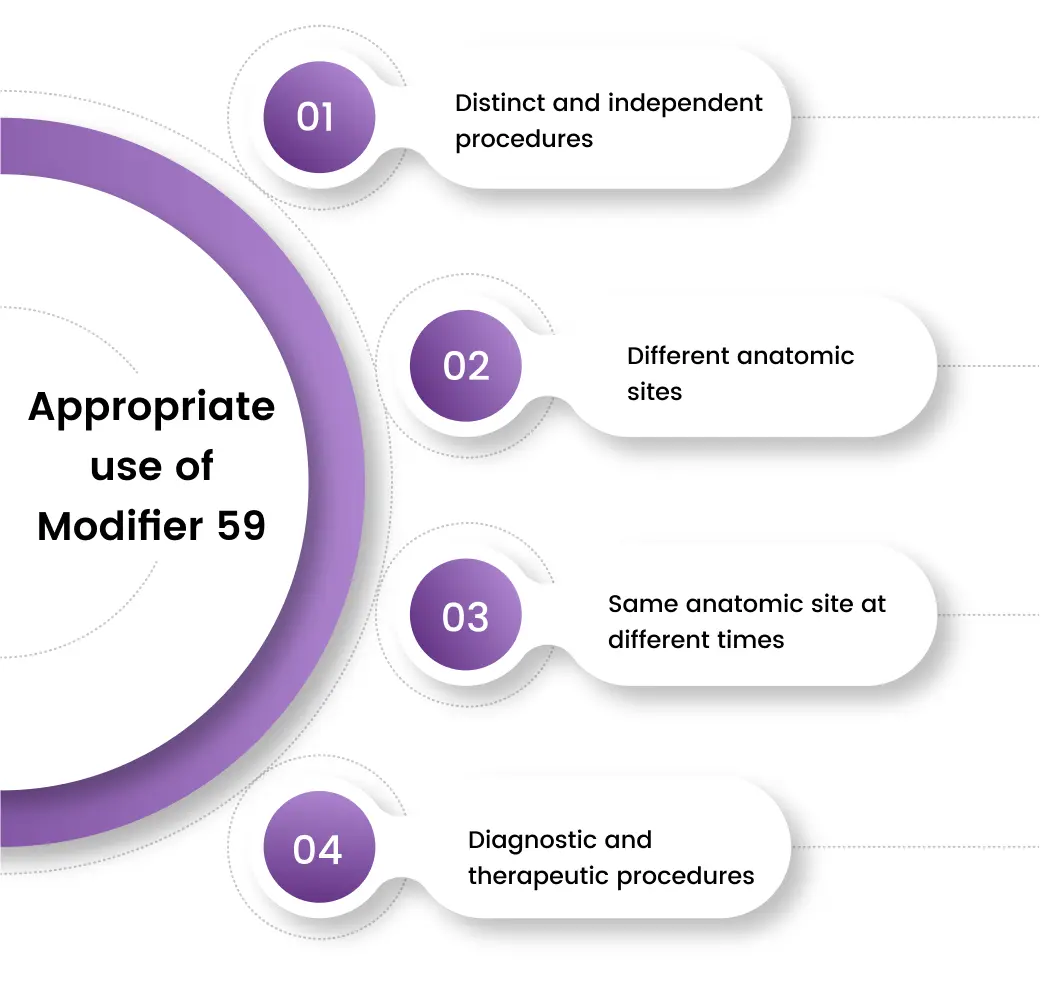
According to official coding guidance, modifier-59 may be used when the services meet one or more of the following criteria:
-
Different session or encounter on the same date of service.
-
Different procedure or surgery.
-
Different anatomical site or organ system.
-
Separate incision, excision, lesion, or injury (or separate area of injury in more extensive cases).
Crucially: modifier-59 should be used only when no more specific modifier is available. Since 2015, CMS has introduced a subset of more descriptive modifiers (known as X‑modifiers: XE, XS, XP, XU) to replace modifier-59 when applicable.
Also: modifier-59 should not be used for E/M (Evaluation & Management) services. If an E/M service is separate and distinct on the same day as a procedure, the correct modifier is generally Modifier 25 — not modifier-59.
Used correctly, modifier-59 helps ensure proper reimbursement for legitimate, distinct services. Used incorrectly — and we’re already seeing mistakes far too often.
The 7 Most Costly Mistakes to Avoid When Using Modifier 59
Let’s explore the most common errors professionals make with modifier-59 — the “red flags” that lead to denials, delays, audits, or lost revenue.
Mistake 1: Overusing Modifier-59 Instead of Checking for More Specific Modifiers
One of the biggest mistakes is using modifier-59 by default, without first determining whether one of the more specific X‑modifiers (XE, XS, XP, XU) is more appropriate.
-
For example, if two procedures occurred on separate anatomical sites, using the X‑modifier XS (“Separate Structure”) is more precise than a generic modifier 59.
-
If services were performed by different practitioners, XP may be more fitting.
Using modifier-59 when a more specific modifier applies signals inexperience or shortcuts — and can make the claim vulnerable to denial or audit.
Mistake 2: Applying Modifier-59 to E/M Services
Modifier-59 is not valid for E/M services. Some billing staff incorrectly append modifier-59 when a procedure and E/M service happen on the same day — but that’s simply wrong. The correct approach is typically to use modifier 25 for the E/M portion, when properly documented as a distinct and significant E/M service.
This misuse often leads to immediate denials or delayed reimbursement.
Mistake 3: Failing to Provide Proper Documentation
Even if two procedures meet the criteria for modifier-59, if the clinical documentation doesn’t clearly demonstrate why the services were distinct — in terms of timing, anatomical site, separate incisions or lesions, or separate encounters — payers may deny the claim or request additional documentation.
Lack of specificity in notes — vague descriptions, failure to note different body sites or separate sessions/times — is one of the leading reasons claims get rejected.
Mistake 4: Using Modifier-59 to “Force” Payment After a Denial
Some billing professionals see a claim denial and respond by tacking on modifier-59 — hoping it will push the claim through reimbursement. This is a serious red flag.
Not only does this misuse risk immediate denial — repeated patterns of unjustified modifier-59 use can trigger audits, recoupments, and compliance investigations by payers or regulators.
Mistake 5: Billing Procedures on the Same Anatomic Site as Distinct
A very common error: coding two procedures on the same anatomical site (or contiguous structures) as if they were separate, and applying modifier-59. Under NCCI rules, modifier-59 is only acceptable when procedures involve different body sites, organ systems, or separate lesions/injuries — not contiguous or part of the same site.
For instance: treating a lesion on a toe and then doing related work on adjacent soft tissue — if considered part of the same anatomical area — should not be split with modifier-59. Doing so improperly invites denial.
Mistake 6: Treating Sequential or Related Procedures as Separate Without Justification
Sometimes billers treat a diagnostic procedure and a therapeutic procedure (or two procedures done sequentially during the same session) as separate, and append modifier-59 — even when the second procedure was inherently part of the first. This is inappropriate if the services are linked or integral, and documentation does not clearly support that they were truly distinct.
For example: a diagnostic test followed immediately by a treatment that is considered part of that diagnostic process — billing both separately with modifier-59 often fails payer scrutiny.
Mistake 7: Not Staying Updated with Coding Guidelines and Payer-specific Rules
Because coding standards evolve — especially with the introduction of X‑modifiers — failing to stay current with coding guidelines, payer policies, or NCCI edits is a big mistake. What may have been acceptable a few years ago may now get flagged or denied.
Many payers now audit modifier 59 claims more aggressively, or may require additional documentation or more specific modifiers.
Best Practices: How to Use Modifier 59 Correctly and Safely
Avoiding these mistakes is about more than just compliance — it’s about protecting your revenue and maintaining the integrity of your billing operations. Here are best practices for using modifier 59 properly:
-
Always evaluate whether a more specific X‑modifier applies first (XE, XS, XP, XU). Use modifier-59 only as a last resort.
-
Ensure thorough, precise documentation — notes should clearly describe why services are distinct: different site, different session/time, different injury, separate incisions or lesions, etc.
-
Avoid using modifier 59 as a “fix” after denial. Instead, assess whether the original billing was appropriate and correct it if needed — don’t just tack on modifier-59 hoping for reimbursement.
-
Do not apply modifier 59 to E/M services; use modifier 25 if a separately identifiable E/M service occurred.
-
Audit your claims internally before submission — especially those using modifier-59 — to catch potential coding errors, documentation gaps, or misuse.
-
Stay updated on coding guidelines, NCCI edits, and payer‑specific rules. What was viable last year may trigger denials this year.
-
Educate your billing and clinical staff on proper use of modifier-59 — and the importance of clinical notes that support it.
Using modifier 59 correctly not only improves reimbursement chances — it also reduces audit risk and strengthens compliance.
Real‑World Examples: When Modifier 59 Makes Sense
Here are a few concrete scenarios where modifier-59 (or a more specific X‑modifier) is appropriately used:
-
A physical therapist provides therapeutic exercises on a patient’s right shoulder in the morning, and later the same day (separate session) provides manual therapy for the left knee. Because the services are separate in anatomical site and are in different sessions, modifier-59 (or possibly XS) is justified.
-
A dermatologist removes a lesion on the left arm and a completely separate lesion on the right thigh during the same visit. Since the sites are anatomically distinct and the lesions are separate, billing each removal with modifier-59 (or XS) is valid.
-
A surgeon performs a surgical procedure in the morning, then later in the day another unrelated procedure on a different organ system. Because the procedures are different and on distinct sites, modifier-59 may be applied.
When documentation clearly supports these distinctions — separate site, separate session/time, separate injury or lesion — modifier-59 helps ensure both services get proper reimbursement.
Why Misusing Modifier 59 Is Risky — Audits, Denials & Revenue Loss
Misusing modifier 59 isn’t just a “coding mistake.” It can lead to serious financial and compliance consequences for practices and providers:
-
Claim denials or delayed payment: If the payer determines that modifier 59 was unjustified (no distinct service, same anatomical site, no documentation), the claim may be denied or payment reduced.
-
Increased audits or pre‑payment review: Payers (especially Medicare and large commercial insurers) monitor modifier 59 usage closely. Frequent or unjustified use can trigger routine audits or recoupment reviews.
-
Reputation and compliance concerns: Patterns of misuse may draw scrutiny from regulatory bodies, potentially leading to penalties or compliance audits, especially if modifier 59 is being used broadly to “unbundle” services without valid justification.
-
Loss of provider/payer trust: Improper coding may increase claim rejections, reduce revenue, and erode trust between providers and payers — which can impact future claim acceptance and payer relationships.
Given these risks, it’s critical for practices (like yours) to implement robust internal policies and regular audits — rather than treat modifier 59 as a “free pass.”
How Icon Billing LLC Helps You Get Modifier 59 Right
At Icon Billing LLC, we specialize in helping practices navigate the complex world of medical billing — including the intricacies of modifiers like modifier 59. Here’s how we support clients:
-
We review your documentation and coding to ensure modifier 59 is justified before claim submission.
-
We validate each claim against NCCI edits and payer‑specific rules, ensuring you’re using the correct modifier (modifier 59 or a more specific X‑modifier) when needed.
-
We implement internal audits and compliance checks to catch potential misuse early.
-
We provide training and guidance to your billing and clinical staff — so your whole team understands when modifier 59 applies and how documentation must support it.
-
We stay updated with CMS, NCCI, and payer policy changes — so you’re never caught off guard when rules evolve.
Our goal is simple: maximize your legitimate reimbursement opportunities while minimizing audit risk and compliance exposure.
Conclusion
Modifier 59 remains a powerful — yet potentially risky — tool in the medical billing toolbox. When used correctly, it ensures truly distinct services are reimbursed fairly. When misused, it becomes a magnet for denials, audits, and lost revenue.
As 2025 unfolds, with increasing scrutiny from payers and evolving guidelines, the importance of accurate modifier 59 usage has never been greater. At Icon Billing LLC, we encourage every practice to treat modifier 59 with respect — not as a shortcut, but as a coding tool that demands careful documentation, precise application, and ongoing oversight.
Avoid the 7 costly mistakes discussed here. Use modifier 59 only when justified, document thoroughly, stay informed, and review claims carefully.
If you’d like professional support for your billing operations — or need help auditing your existing modifier 59 use — feel free to contact Icon Billing LLC. We’re here to help you code right, get paid fairly, and stay compliant.
Frequently Asked Questions (FAQs)
What exactly does modifier 59 mean?
Modifier 59 stands for “Distinct Procedural Service.” It indicates that a procedure or service billed on the same day as another was separate, independent, and not typically bundled — justifying separate reimbursement.
When is it appropriate to use modifier 59?
Appropriate use includes services on different anatomical sites, separate sessions/encounters, different procedures or surgeries, separate incisions or lesions, or distinct injuries — provided no more specific modifier applies.
Can I use modifier 59 for an E/M service plus a procedure on the same day?
No. Modifier 59 is not valid for E/M services. If you have a separately identifiable E/M visit plus a procedure, use modifier 25 for the E/M portion (assuming documentation supports it).
What are the X‑modifiers and when should I use them instead of modifier 59?
Since 2015, there are more specific modifiers that capture common scenarios:
-
XE — Separate Encounter
-
XS — Separate Structure / Site
-
XP — Separate Practitioner
-
XU — Unusual Non‑Overlapping Service
Use these when they more precisely describe the relationship between procedures, before resorting to a generic modifier 59.
What happens if modifier 59 is misused?
Misuse can lead to claim denials, delayed payment, recoupments, audits, compliance penalties, and reputational damage with payers.
How can I avoid errors when using modifier 59?
Ensure meticulous documentation; confirm that the services are truly distinct; use X‑modifiers when appropriate; audit claims before submission; stay updated on payer and coding guidelines; and provide training to your billing and clinical staff.