
Introduction
In the world of medical billing, efficiency is paramount. With practices and healthcare providers constantly looking for ways to streamline operations, ensuring accurate billing becomes a key factor in success. One of the most powerful tools to enhance medical billing efficiency is an RVU calculator. By incorporating an RVU calculator into your medical practice, you can not only simplify billing but also improve the accuracy of claims submitted to insurance companies.
But what is an RVU calculator, and why is it so vital for medical billing? In this post, we’ll dive deep into understanding how an RVU calculator works and the numerous benefits it offers to medical practices.

What is an RVU Calculator?
RVU stands for Relative Value Unit, a metric used to measure the value of services provided by healthcare professionals. Each medical service or procedure is assigned a certain number of RVUs based on factors like complexity, time required, and skill needed.
An RVU calculator helps to quantify and calculate the value of these medical services efficiently. By using an RVU calculator, medical billers can more accurately determine how much to charge for each service, ensuring that practices are paid appropriately for their work.
The RVU calculator accounts for several key factors:
-
Physician Work (Work RVU): The effort involved in performing the service.
-
Practice Expense (PE RVU): The overhead cost associated with providing the service.
-
Malpractice Expense (MP RVU): The cost of malpractice insurance.
Together, these factors contribute to the total RVU, which is then used to determine reimbursement rates.
Why is an RVU Calculator Important in Medical Billing?
Using an RVU calculator can drastically simplify the billing process for medical practices, ensuring that the financial side of the business runs smoothly. Here are some of the key reasons why:
1. Improved Accuracy
An RVU calculator removes the guesswork from determining how much to bill. Medical practices often struggle with undercharging or overcharging due to inaccurate billing codes or miscalculations of the RVUs. An RVU calculator ensures that every service is billed appropriately, resulting in fewer errors and reduced chances of claim rejection.
2. Time Savings
Manual calculation of RVUs can be time-consuming, especially for busy practices. By using an RVU calculator, the process is automated, freeing up valuable time for medical staff to focus on patient care.
3. Optimized Reimbursement
An RVU calculator helps ensure that your practice is paid fairly. By calculating the correct RVUs for each service, you are more likely to receive the proper reimbursement rates from insurance companies. This also helps prevent revenue loss due to underbilling.
4. Cost-Effective Billing
Billing can be expensive and resource-heavy, especially for large practices. By using an RVU calculator, you can reduce the need for manual billing and focus on maximizing your practice’s revenue. It ensures that every aspect of your billing process is efficient, helping to lower operational costs over time.
5. Supports Value-Based Care
In the era of value-based care, RVUs are a crucial metric. Practices that use an RVU calculator can better align their billing with the value of care provided, ensuring they are compensated according to the services delivered.
How Does an RVU Calculator Work?
At the core of an RVU calculator is its ability to take a healthcare provider’s data and calculate RVUs for each service rendered. Here’s a breakdown of how the RVU calculation process works:
-
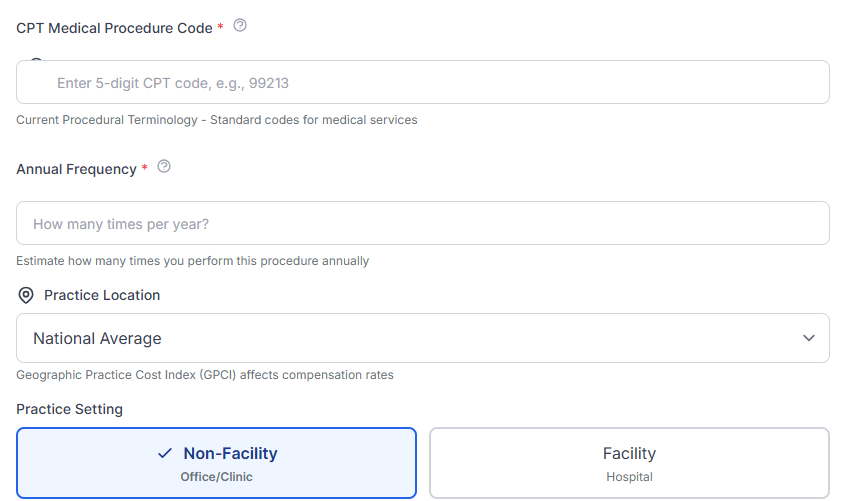
Input Data: The healthcare provider enters the relevant data, including the procedure or service rendered, the time spent, and the level of complexity involved.
-
Assign RVUs: Based on the input data, the RVU calculator assigns specific RVUs to each procedure. This is done according to standard values set by the Centers for Medicare & Medicaid Services (CMS).
-
Calculate Total RVU: The RVU calculator will add up the RVUs for the various components (Physician Work, Practice Expense, and Malpractice Expense) to provide a total RVU for the service.
-
Determine Reimbursement: The total RVU is then used to calculate the amount to be billed. Using the RVU multiplier (often based on geographical location), the calculator determines the payment that should be received for the service.
Benefits of Using an RVU Calculator for Medical Billing
Now that we understand the mechanics behind an RVU calculator, let’s take a closer look at how it can specifically benefit your medical practice.
1. Reduces Billing Errors
Medical billing can be riddled with errors, whether it’s due to incorrect CPT codes, uncalculated RVUs, or errors in insurance billing. Using an RVU-calculator ensures that RVUs are calculated correctly, which helps reduce billing errors and speeds up the claims process.
2. Ensures Consistency
Human errors in manual RVU calculation can lead to discrepancies in billing. An RVU-calculator ensures consistency across all procedures, minimizing the chances of mistakes in calculations. This consistency is vital for maintaining accurate financial records and ensuring fairness in reimbursements.
3. Keeps Your Practice Up to Date
RVU values change over time based on various factors, including updates from CMS and the healthcare industry. An RVU-calculator helps keep your practice up to date with the latest values and ensures your billing reflects these changes. This eliminates the need for your staff to manually track changes, reducing overhead.
4. Enhances Transparency
Insurance companies and patients demand transparency in medical billing. By using an RVU-calculator, you can break down the cost of each service with accuracy, making it easier to communicate the billing details to patients and insurance companies. This transparency can help resolve disputes and improve patient satisfaction.
Choosing the Right RVU Calculator
There are many different RVU calculators available, but not all of them are created equal. When choosing an RVU-calculator for your practice, consider the following:
-
Integration with Other Systems: Ensure that the RVU-calculator can integrate with your practice management system or Electronic Health Record (EHR) system.
-
Accuracy and Reliability: Look for calculators that use up-to-date RVU values and that have been tested for accuracy.
-
User-Friendliness: The RVU-calculator should be easy to use for both medical professionals and billing staff.
-
Support for Value-Based Care: If your practice is transitioning to value-based care, choose an RVU-calculator that supports the unique billing requirements of value-based models.
-
Cost: Consider the overall cost of the calculator and how it fits within your practice’s budget.
Common Mistakes to Avoid with RVU Calculators
While an RVU-calculator can significantly improve your billing process, there are some common mistakes practices make:
-
Overlooking Regular Updates: RVU values change, and an outdated calculator could result in underbilling. Ensure your RVU-calculator is regularly updated with the latest values.
-
Not Fully Understanding the Calculator: While RVU-calculators are designed to simplify the process, understanding the basics of RVU calculation is still important. Don’t rely solely on the calculator without understanding how it works.
-
Ignoring Integration: Make sure the RVU-calculator integrates seamlessly with your existing billing systems to avoid unnecessary manual work.
Conclusion
An RVU calculator is an indispensable tool for medical billing. By automating and streamlining the process, it ensures that your practice is billing accurately and efficiently. Whether you are a small practice or a large healthcare organization, adopting an RVU-calculator can save time, reduce errors, and optimize reimbursement rates.
If you’re looking to improve your billing process, consider investing in a reliable RVU-calculator today. With the right tool, your practice will be positioned for greater financial success and enhanced operational efficiency.