
CHF ICD 10
Congestive heart failure (CHF) remains one of the most common and expensive chronic conditions treated in U.S. healthcare. For physicians, accurate documentation and coding are no longer administrative details—they directly affect reimbursement, risk adjustment, quality metrics, and compliance.
At the center of this challenge lies chf icd 10 coding.
When chf icd 10 is used incorrectly, even excellent clinical care can result in denied claims, downcoded visits, or audit exposure. When used properly, chf icd 10 supports your medical decision-making, reflects patient acuity, and ensures your practice is reimbursed fairly.
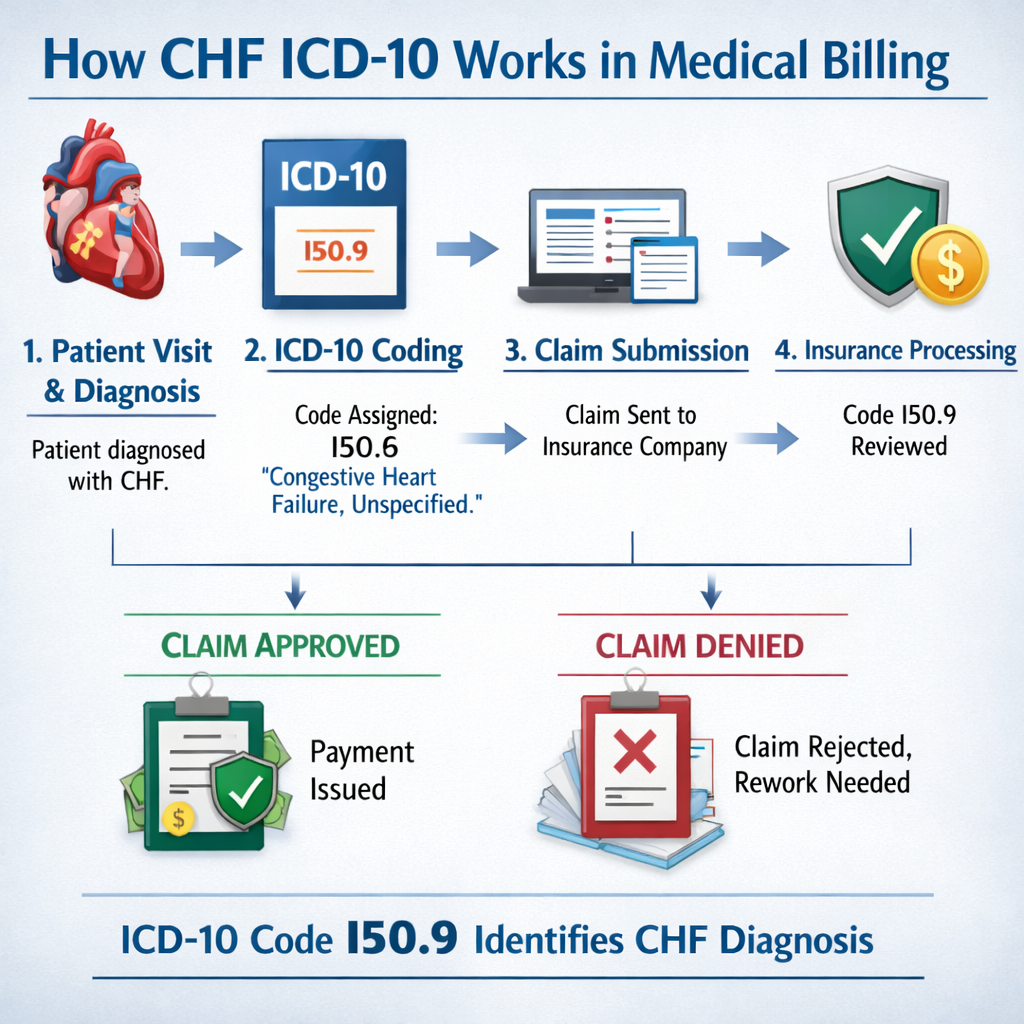
This guide from Icon Billing LLC is written specifically for U.S. physicians. It explains how chf icd 10 works, where errors occur, and how your documentation can protect revenue while improving patient care.
Understanding CHF in the ICD-10 Environment
Unlike ICD-9, ICD-10 is highly granular. CHF is no longer a single diagnosis—it is a family of conditions requiring specificity in:
-
Type of heart failure
-
Acuity (acute, chronic, or acute on chronic)
-
Ventricular involvement
-
Underlying etiology
The chf icd 10 code set falls primarily under category I50.-, but that category branches into dozens of options.
For example:
| Condition | ICD-10 Code |
|---|---|
| Acute systolic heart failure | I50.21 |
| Chronic systolic heart failure | I50.22 |
| Acute on chronic systolic heart failure | I50.23 |
| Acute diastolic heart failure | I50.31 |
| Chronic diastolic heart failure | I50.32 |
| Combined systolic & diastolic HF | I50.4- |
Using chf icd 10 accurately requires that your documentation clearly states:
-
Systolic, diastolic, or combined
-
Acute, chronic, or acute on chronic
-
Clinical status during the encounter
Without this, coders must default to unspecified codes—often leading to reduced reimbursement and payer scrutiny.
Truth #1: “CHF” Alone Is No Longer Enough
Simply documenting “CHF” or “heart failure” is insufficient in the ICD-10 era.
From a coding perspective, “CHF” without modifiers forces coders to use I50.9 – Heart failure, unspecified, one of the weakest chf icd 10 options available.
Unspecified codes:
-
Lower RAF scores in value-based models
-
Trigger payer audits
-
Reduce E/M complexity support
-
Undermine population health reporting
Your note should clearly reflect:
“Chronic systolic heart failure, stable on guideline-directed therapy.”
That single sentence empowers your billing team to assign a precise chf icd 10 code that fully reflects patient acuity.
Truth #2: Acuity Drives Reimbursement
In chf icd 10, acuity matters.
Compare:
-
I50.22 – Chronic systolic HF
-
I50.23 – Acute on chronic systolic HF
The second code supports:
-
Higher MDM complexity
-
Increased risk stratification
-
Justification for intensive management
If a patient presents with volume overload, dyspnea, or decompensation—and you treat them accordingly—your documentation must say “acute on chronic”.
Without those words, your coder cannot assign the correct chf icd 10 code, even if your clinical actions clearly indicate decompensation.
Truth #3: Etiology Still Matters
CHF rarely exists in isolation. Common underlying causes include:
-
Hypertensive heart disease
-
Ischemic cardiomyopathy
-
Valvular disease
-
Alcohol-induced cardiomyopathy
ICD-10 allows combination coding such as:
-
I11.0 – Hypertensive heart disease with heart failure
-
I25.5 – Ischemic cardiomyopathy
When paired with the appropriate chf icd 10 code, these combinations improve:
-
Clinical clarity
-
Risk adjustment accuracy
-
Longitudinal patient profiling
Your documentation should connect the dots:
“Chronic systolic HF due to ischemic cardiomyopathy.”
This supports both the etiology and the precise chf icd 10 classification.
Truth #4: Documentation Must Match Clinical Thinking
Physicians often think in terms of:
-
NYHA class
-
Ejection fraction
-
Guideline-directed therapy
-
Volume status
Coders, however, can only use what is explicitly written.
Instead of:
“CHF stable.”
Use:
“Chronic systolic heart failure, NYHA class II, euvolemic on Entresto and carvedilol.”
That one sentence supports:
-
Chronic systolic chf icd 10
-
Clinical stability
-
Complexity of management
-
Medication burden
This alignment between clinical reasoning and documentation is what protects revenue.
Truth #5: CHF Impacts Every E/M Level
Under 2021 E/M rules, medical decision-making drives coding. Heart failure automatically increases complexity due to:
-
Chronic illness with risk of exacerbation
-
Ongoing medication management
-
Potential for hospitalization
When chf icd 10 is documented precisely, it strengthens:
-
Moderate and high MDM selection
-
Justification for extended visits
-
Support for care coordination
Vague heart failure documentation weakens your E/M position.
Truth #6: Payers Scrutinize Heart Failure Codes
CHF is a high-cost condition. Payers monitor it closely for:
-
Upcoding
-
Lack of clinical support
-
Inconsistent documentation
-
Overuse of acute codes
Accurate chf icd 10 usage protects you during:
-
Medicare audits
-
Commercial payer reviews
-
Risk adjustment validation
Clear notes, consistent terminology, and alignment with treatment plans are your best defense.
Truth #7: Your Billing Partner Matters
Even perfect documentation fails without expert interpretation.
At Icon Billing LLC, we:
-
Audit CHF documentation patterns
-
Train providers on chf icd 10 specificity
-
Align notes with payer expectations
-
Reduce denials related to heart failure
-
Improve revenue without increasing risk
We act as an extension of your practice, ensuring that chf icd 10 reflects the care you truly deliver.
Quick Reference: What to Document for CHF
Every CHF encounter should answer:
-
Is it systolic, diastolic, or combined?
-
Is it acute, chronic, or acute on chronic?
-
What is the underlying cause?
-
What is the current clinical status?
-
What management is being performed?
Answering these ensures correct chf icd 10 assignment every time.

Common CHF ICD-10 Errors
-
Writing only “CHF”
-
Failing to state acuity
-
Mixing systolic and diastolic terms
-
Treating decompensation but documenting “stable”
-
Copy-forward notes with outdated status
Each error weakens your chf icd 10 profile and exposes revenue to loss.
FAQ for Physicians
Is “CHF” still acceptable terminology?
Clinically yes—but not for coding. Always expand it in your assessment so chf icd 10 can be assigned accurately.
Do I need to document EF?
EF is helpful but not required. What matters most is stating systolic vs. diastolic for chf icd 10 purposes.
What if I’m unsure of acuity?
Document your clinical impression: “possible acute on chronic HF” or “no evidence of decompensation today.” Coders can work with this.
Final Thought for U.S. Physicians
Heart failure is complex. Your documentation should be just as precise.
When chf icd 10 reflects the reality of your care:
-
Your patients’ acuity is recognized
-
Your outcomes data improves
-
Your reimbursement aligns with effort
-
Your audit risk decreases
At Icon Billing LLC, we specialize in translating excellent clinical care into accurate, compliant revenue.